

Metric: Difference between revisions
Created page with "In mathematics, a '''metric''' or '''distance function''' is a function that defines a rigorous concept of distance between each pair of elements in a given set. By generalizing the physical concept of distance, metrics allow mathematicians to define topological concepts such as open and closed sets, continuity, convergence, and limits in highly abstract spaces. A set equipped with a metric is called a metric sp..." |
No edit summary |
||
| (4 intermediate revisions by the same user not shown) | |||
| Line 2: | Line 2: | ||
== Definitions == | == Definitions == | ||
Let <math>X</math> be a given | Let <math>X</math> be a given nonempty set. A metric on <math>X</math> is a function | ||
<math display="block">d: X\times X\to \mathbb{R},</math> | |||
that satisfies the following four properties for all <math>x,y,z\in X</math>: | that satisfies the following four properties for all <math>x,y,z\in X</math>: | ||
# ''' | # '''Nonnegativity:''' <math>d(x,y)\ge 0</math> | ||
# '''Identity of indiscernibles:''' <math>d(x,y) = 0 \Longleftrightarrow x=y</math> | # '''Identity of indiscernibles:''' <math>d(x,y) = 0 \Longleftrightarrow x=y</math> | ||
# '''Symmetry:''' <math>d(x,y)=d(y,x)</math> | # '''Symmetry:''' <math>d(x,y)=d(y,x)</math> | ||
# '''Triangle inequality:''' <math>d(x,z)\le d(x,y)+d(y,z)</math>. | # '''Triangle inequality:''' <math>d(x,z)\le d(x,y)+d(y,z)</math>. | ||
The value <math>d(x,y)</math> is called the distance between <math>x</math> and <math>y</math>. | |||
== Properties == | == Properties == | ||
{{Property|property= | {{Property|property=Nonnegativity is implied by the other three properties.}} | ||
{{Proof|proof=Let <math>x,y\in X</math>. By the triangle inequality, | |||
<math display="block">d(x,x)\le d(x,y)+d(y,x).</math> | <math display="block">d(x,x)\le d(x,y)+d(y,x).</math> | ||
By the identity of | |||
By the identity of indiscernibles, <math>d(x,x)=0</math>. Thus | |||
<math display="block">0\le d(x,y)+d(y,x).</math> | <math display="block">0\le d(x,y)+d(y,x).</math> | ||
By symmetry, <math>d(x,y)=d(y,x)</math>. | |||
By symmetry, <math>d(x,y)=d(y,x)</math>. Therefore, | |||
<math display="block">\begin{align} | <math display="block">\begin{align} | ||
0&\le d(x,y)+d(x,y)\ | |||
0&\le 2d(x,y)\ | |||
0&\le d(x,y). | |||
\end{align}</math>}} | \end{align}</math> | ||
Hence <math>d(x,y)\ge 0</math>.}} | |||
{{Property|title=Reverse triangle inequality|property=Suppose that <math>(X,d)</math> is a metric space and <math>x,y,z\in X</math>. Then | |||
<math display="block">|d(x,y)-d(x,z)|\le d(y,z).</math>}} | |||
{{Proof|proof=By the triangle inequality, | |||
<math display="block">d(x,y)\le d(x,z)+d(z,y).</math> | |||
By symmetry, <math>d(z,y)=d(y,z)</math>. Therefore, | |||
<math display="block">d(x,y)-d(x,z)\le d(y,z).</math> | |||
Using the triangle inequality again, | |||
<math display="block">d(x,z)\le d(x,y)+d(y,z).</math> | |||
Rearranging gives | |||
<math display="block">d(x,z)-d(x,y)\le d(y,z).</math> | |||
Thus both | |||
<math display="block">d(x,y)-d(x,z)\le d(y,z)</math> | |||
and | |||
<math display="block">d(x,z)-d(x,y)\le d(y,z)</math> | |||
hold. Hence | |||
<math display="block">|d(x,y)-d(x,z)|\le d(y,z).</math>}} | |||
{{Property|title=Distance from a fixed point is continuous|property=Let <math>(X,d)</math> be a metric space and let <math>a\in X</math>. The function <math>f:X\to\mathbb{R}</math> defined by | |||
<math display="block">f(x)=d(x,a)</math> | |||
is continuous.}} | |||
{{Proof|proof=For any <math>x,y\in X</math>, the reverse triangle inequality gives | |||
<math display="block">|d(x,a)-d(y,a)|\le d(x,y).</math> | |||
Let <math>\varepsilon>0</math>. If <math>d(x,y)<\varepsilon</math>, then | |||
<math display="block">|f(x)-f(y)|=|d(x,a)-d(y,a)|<\varepsilon.</math> | |||
Therefore <math>f</math> is continuous.}} | |||
== Open balls == | |||
Let <math>(X,d)</math> be a metric space. For <math>a\in X</math> and <math>r>0</math>, the '''open ball''' with centre <math>a</math> and radius <math>r</math> is the set | |||
<math display="block">B_r(a)={x\in X:d(x,a)<r}.</math> | |||
Similarly, the '''closed ball''' with centre <math>a</math> and radius <math>r</math> is the set | |||
<math display="block">\overline{B}_r(a)={x\in X:d(x,a)\le r}.</math> | |||
Open balls are fundamental because they describe the local structure of a metric space. | |||
== Metric topology == | |||
Every metric space naturally gives rise to a [[topology]]. A subset <math>U\subseteq X</math> is called '''open''' if for every <math>x\in U</math>, there exists some <math>r>0</math> such that | |||
<math display="block">B_r(x)\subseteq U.</math> | |||
A subset <math>C\subseteq X</math> is called '''closed''' if its complement <math>X\setminus C</math> is open. | |||
This topology is called the '''metric topology''' induced by <math>d</math>. Thus metrics allow concepts from analysis and topology to be studied in a common framework. | |||
== Convergence == | |||
Let <math>(X,d)</math> be a metric space, and let <math>(x_n)</math> be a sequence in <math>X</math>. The sequence <math>(x_n)</math> is said to '''converge''' to <math>x\in X</math> if | |||
<math display="block">\lim_{n\to\infty} d(x_n,x)=0.</math> | |||
Equivalently, for every <math>\varepsilon>0</math>, there exists <math>N\in\mathbb{N}</math> such that whenever <math>n\ge N</math>, | |||
<math display="block">d(x_n,x)<\varepsilon.</math> | |||
In this case, one writes | |||
<math display="block">x_n\to x.</math> | |||
{{Property|title=Uniqueness of limits|property=In a metric space, a convergent sequence has at most one limit.}} | |||
{{Proof|proof=Suppose that <math>x_n\to x</math> and <math>x_n\to y</math>. By the triangle inequality, | |||
<math display="block">d(x,y)\le d(x,x_n)+d(x_n,y).</math> | |||
Taking the limit as <math>n\to\infty</math>, both terms on the right tend to <math>0</math>. Hence | |||
<math display="block">d(x,y)=0.</math> | |||
By the identity of indiscernibles, <math>x=y</math>. Therefore the limit is unique.}} | |||
== Continuity == | |||
Let <math>(X,d_X)</math> and <math>(Y,d_Y)</math> be metric spaces. A function <math>f:X\to Y</math> is '''continuous at''' <math>a\in X</math> if for every <math>\varepsilon>0</math>, there exists <math>\delta>0</math> such that whenever | |||
<math display="block">d_X(x,a)<\delta,</math> | |||
one has | |||
<math display="block">d_Y(f(x),f(a))<\varepsilon.</math> | |||
The function <math>f</math> is called '''continuous''' if it is continuous at every point of <math>X</math>. | |||
This definition generalizes the usual epsilon delta definition of continuity from real analysis. | |||
== Examples == | |||
=== Standard metric on the real line === | |||
On <math>\mathbb{R}</math>, the usual metric is | |||
<math display="block">d(x,y)=|x-y|.</math> | |||
This metric agrees with the ordinary notion of distance between real numbers. | |||
=== Euclidean metric === | |||
On <math>\mathbb{R}^n</math>, the Euclidean metric is | |||
<math display="block">d(x,y)=\sqrt{\sum_{i=1}^{n}(x_i-y_i)^2},</math> | |||
where <math>x=(x_1,\ldots,x_n)</math> and <math>y=(y_1,\ldots,y_n)</math>. | |||
=== Discrete metric === | |||
On any nonempty set <math>X</math>, the discrete metric is defined by | |||
<math display="block">d(x,y)= | |||
\begin{cases} | |||
0, & x=y,\ | |||
1, & x\ne y. | |||
\end{cases}</math> | |||
This metric treats every two distinct points as being exactly distance <math>1</math> apart. | |||
=== Taxicab metric === | |||
On <math>\mathbb{R}^n</math>, the taxicab metric is | |||
<math display="block">d(x,y)=\sum_{i=1}^{n}|x_i-y_i|.</math> | |||
In <math>\mathbb{R}^2</math>, this measures distance by moving only in coordinate directions, like travelling along the streets of a rectangular city grid. | |||
=== Supremum metric === | |||
On <math>\mathbb{R}^n</math>, the supremum metric is | |||
<math display="block">d(x,y)=\max_{1\le i\le n}|x_i-y_i|.</math> | |||
This metric measures the largest coordinate difference between two points. | |||
== Related notions == | |||
A '''pseudometric''' is similar to a metric, but it does not require that <math>d(x,y)=0</math> implies <math>x=y</math>. Thus two distinct points may have distance <math>0</math>. | |||
A '''norm''' on a vector space gives rise to a metric by defining | |||
<math display="block">d(x,y)=|x-y|.</math> | |||
For example, the usual absolute value on <math>\mathbb{R}</math> gives the standard metric | |||
<math display="block">d(x,y)=|x-y|.</math> | |||
== See also == | |||
* [[Metric space]] | |||
* [[Topology]] | |||
* [[Open set]] | |||
* [[Closed set]] | |||
* [[Continuity]] | |||
* [[Convergence]] | |||
* [[Normed vector space]] | |||
[[Category:Metric spaces]] | |||
[[Category:Topology]] | |||
[[Category:Mathematical analysis]] | |||
Latest revision as of 22:01, 29 June 2026
In mathematics, a metric or distance function is a function that defines a rigorous concept of distance between each pair of elements in a given set. By generalizing the physical concept of distance, metrics allow mathematicians to define topological concepts such as open and closed sets, continuity, convergence, and limits in highly abstract spaces. A set equipped with a metric is called a metric space.
Definitions
Let  be a given nonempty set. A metric on is a function

that satisfies the following four properties for all  :
:
- Nonnegativity:

- Identity of indiscernibles:

- Symmetry:

- Triangle inequality:
 .
.
The value  is called the distance between
  and
and  .
.
Properties
Nonnegativity is implied by the other three properties.
Let  . By the triangle inequality,

By the identity of indiscernibles,  . Thus

By symmetry, . Therefore,
Hence .
Suppose that  is a metric space and . Then

By the triangle inequality,

By symmetry,  . Therefore,

Using the triangle inequality again,

Rearranging gives

Thus both

and

hold. Hence
Let be a metric space and let  . The function
  defined by

is continuous.
For any , the reverse triangle inequality gives

Let  . If
. If  , then

Therefore  is continuous.
Open balls
Let be a metric space. For and  , the open ball with centre
  and radius
  is the set

Similarly, the closed ball with centre and radius is the set

Open balls are fundamental because they describe the local structure of a metric space.
Metric topology
Every metric space naturally gives rise to a topology. A subset  is called open if for every
  , there exists some such that

A subset  is called closed if its complement
  is open.
This topology is called the metric topology induced by  . Thus metrics allow concepts from analysis and topology to be studied in a common framework.
Convergence
Let be a metric space, and let  be a sequence in . The sequence is said to converge to
  if
if

Equivalently, for every , there exists  such that whenever
  ,
,

In this case, one writes

In a metric space, a convergent sequence has at most one limit.
Suppose that  and
and  . By the triangle inequality,

Taking the limit as  , both terms on the right tend to
  . Hence

By the identity of indiscernibles,  . Therefore the limit is unique.
Continuity
Let  and
and  be metric spaces. A function
  is continuous at if for every , there exists
  such that whenever

one has

The function is called continuous if it is continuous at every point of .
This definition generalizes the usual epsilon delta definition of continuity from real analysis.
Examples
Standard metric on the real line
On  , the usual metric is

This metric agrees with the ordinary notion of distance between real numbers.
Euclidean metric
On  , the Euclidean metric is
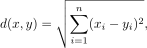
where  and
and  .
.
Discrete metric
On any nonempty set , the discrete metric is defined by
This metric treats every two distinct points as being exactly distance  apart.
Taxicab metric
On , the taxicab metric is
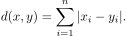
In  , this measures distance by moving only in coordinate directions, like travelling along the streets of a rectangular city grid.
Supremum metric
On , the supremum metric is

This metric measures the largest coordinate difference between two points.
Related notions
A pseudometric is similar to a metric, but it does not require that  implies . Thus two distinct points may have distance .
A norm on a vector space gives rise to a metric by defining
For example, the usual absolute value on gives the standard metric