

Seifert-Van Kampen theorem
Statement
Let  be a topological space and let
  be an open cover of .
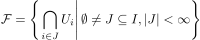
Let  be the set of all finite non-empty intersections of members of
  :
:
.
Regard as a category whose objects are the elements of and in which there is a unique morphism  whenever
  .
.
Let  be the functor that sends each
  to its fundamental groupoid
  and each inclusion
  to the induced morphism of groupoids.
Then the canonical morphism
Mathepedia render error: ! Undefined control sequence. l.9 \colim _{V\in \mathcal{F}}\Pi_1(V)\to \Pi_1(X) No pages of output. Transcript written on /var/lib/mathepedia-renderer/cache/mathepedia-2e761aa3b5a 2d9c79e148ea5605e1125abb0e33bc542c2d979db3c6cedd86f7c-9hl7aqma/diagram.log.
is an isomorphism of groupoids.