


Commutator
A commutator is an algebraic expression that measures the failure of two elements to commute. It occurs throughout abstract algebra, particularly in group theory, ring theory, and linear algebra.
If two elements commute, their commutator is trivial. More generally, the commutator describes the obstruction to exchanging the order of two operations. Commutators are fundamental in the study of noncommutative structures and in the construction of invariants such as the derived subgroup, the lower central series, and the Lie bracket.
Conventions
In group theory, two conventions are commonly used:
- Left convention:

- Right convention:

These differ by inversion:

Unless otherwise stated, this article uses the left convention.
In ring theory and linear algebra, the standard convention is

Definition
Groups
Let  be a group, and let
  . Their commutator is

One has

where  is the identity element.
Rings
Let  be a ring, and let
  . Their commutator is
This vanishes precisely when  and
and  commute.
Linear transformations
For linear transformations  on a vector space
  , equivalently for square matrices, the commutator is
This is the ring commutator in the endomorphism ring  .
.
Properties
Group identities
For all  ,
,


where

Also,


Ring identities
For all  ,
,



The commutator also satisfies the Jacobi identity:

For matrices,

Derived subgroup
The subgroup generated by all group commutators is the derived subgroup or commutator subgroup of :

It satisfies:
 is a normal subgroup
 is abelian
- is abelian if and only if

The quotient

is called the abelianization of .
Lie algebras
In a Lie algebra, the bracket operation often arises from the commutator in an associative algebra:

Thus every associative algebra determines a Lie algebra by using the commutator as its bracket.
For the matrix algebra  , this gives the Lie algebra

Examples
Symmetric group
In the symmetric group  , let
, let

Then

so  and
and  do not commute.
Matrices
Let

Then
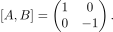
Hence and do not commute.